My work is a byproduct, an artifact, and a love letter to a moment in time spent noticing. I traverse local patches of wildness slowly and lovingly, observing the weeping sap of eastern white pines, how ghost flowers decay, and the spring hum of spiders. While the deer flee, the black-capped chickadees perch upon my easel. I am a witness to the secret choreographies of the woods—a beaver building a dam, a coyote watching from the brush. My sites are curious places that invite an investigation of both the self and the surroundings. Like Henry Wadsworth Longfellow, I seek the harmonies and discords between the human and the wild. On this uneven ground, between glacial erratic and dying beech tree, I write my love letters in ink and paint. Their words are composed of varying hues and gestural marks—a transcendent, constructed tongue used to talk to the mute.
Process: Plein Air & In-Studio
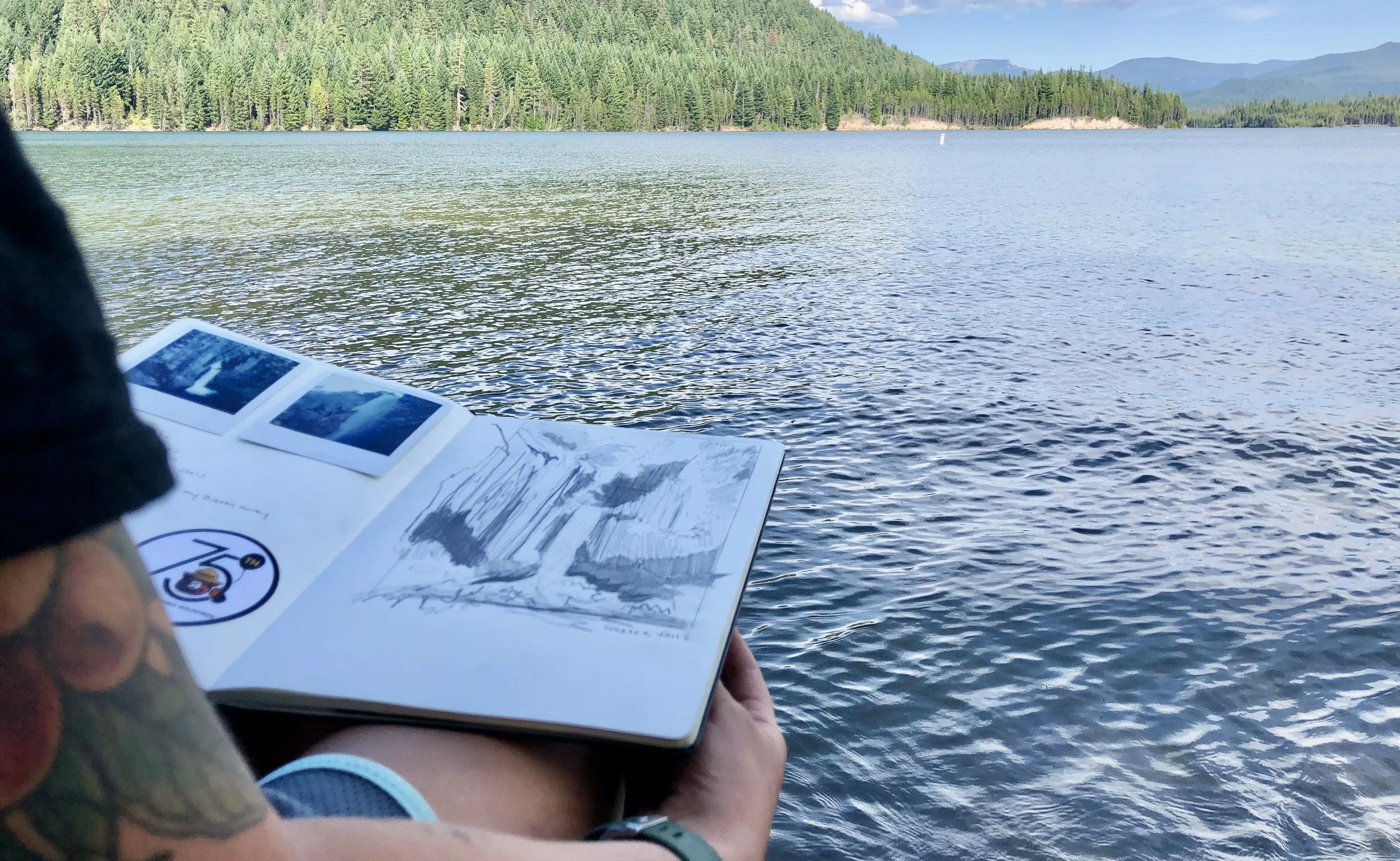
My practice is a dialogue between the disciplined observation of the field and the reactive freedom of the studio. While I prefer to work onsite, the New England climate limits plein air sessions to eight months of the year. These sessions are physical studies of endurance; I spend up to eight hours withstanding the elements to study the value structure, local color, and volumetric form of my subjects. This routine requires specific gear and mental grit, resulting in paintings titled by the date of their creation—a system that reinforces the work as a physical relic of time and geography.
When ideas remain unresolved in the field, I turn to the studio. Residencies at the Penland School of Craft and Millay Arts have allowed for this transition into invention and color play. In the studio, I move away from "local color" to explore a more gestural language in gouache and ink. These works act as a translation, shifting from the technical accuracy of the field to the emotional resonance of memory.
Rock & Root (2022-Present)
Where tree meets earth is a place of whimsy and resilience. I paint roots because they are curious, strong, and stubborn—a quiet representation of natural force. Between 2022 and 2024, I painted the root systems of twenty trees in a single grove at Ravenswood Park. As I became attuned to the rhythms of the site, I grew uneasy with my own presence and the trail boundary—that necessary dividing line between human and nature maintained for preservation. Should I be here, an intruder protected by DEET? After an encounter with an owl protecting its fledglings, I felt the weight of my intrusion and chose to leave Ravenswood to let the grove heal. This body of work is an act of memory and reconciliation, exploring the ebbing and flowing systems that speak of a wisdom I can never fully possess.
Overgrowth (2020-2022)
What emerges from damaged landscapes? This body of work investigates local Superfund sites that have begun to heal from decades of industrialization. My process involves conducting site visits to these locations to identify resilient plant life, capturing the landscape through photographs and drawings which I then manipulate in the studio. To represent these spaces, I use almost-violent expressive marks and artificial materials—fluorescent paint, heavy metal oils, and glitter pens—to remind us of the invisible agents and contaminants that create a new sublime. In parallel, I catalog "weeds," the native spontaneous growth plants that color our urban landscapes and work to absorb heavy metals from the soil despite efforts to eradicate them with herbicides.
The Alpine Zone (2018-2020)
This work is rooted in the "grit" of the New England 67 Challenge, summiting all 4,000-foot peaks across Vermont, New Hampshire, and Maine. Early on, I hiked for majestic views, but I eventually realized those vistas were a short part of a day spent walking with a gaze fixed on the ground for safety. I began to question my biases: why represent a day of looking at the ground with a painting of a summit? These paintings celebrate my development as a human connecting with my time on earth, honoring those early moments in my hiking experience. From here, my work moved away from the "majestic view" to the technical accuracy of the hiker’s downward gaze, igniting the spark for bodies of work Overgrowth, Rock & Root and my current plein air work.